

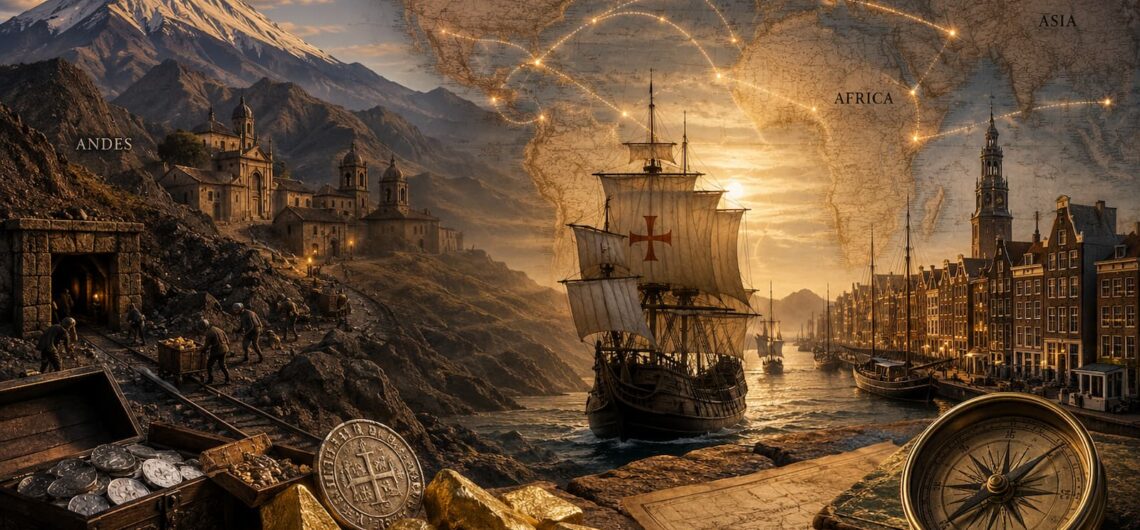
How the Gold and Silver of the Americas Helped Build the Modern World
For many people, the story of the Spanish conquest begins and ends with gold.
Images of lost treasures, Inca temples, pirate fleets, and Spanish galleons dominate the imagination. But the true story is far larger — and far more important.
The gold and silver extracted from the Americas did not simply disappear into royal vaults or legendary treasure chests.
A significant portion of that wealth became part of the financial foundation of the modern world.
From the mountains of the Andes to the ports of Europe and the markets of Asia, American precious metals helped accelerate the rise of international commerce, banking, maritime trade, and the first truly global economy in human history.
And much of it began here — in the high mountains and ancient civilizations of the Americas.
From the Andes to the World
The Metal That Connected Continents
American gold and silver did more than enrich empires. They moved through ports, banks, ships, and markets, helping connect the Andes, Europe, Africa, and Asia into one of the first global commercial systems in history.
The Mountains That Fed an Empire
After the arrival of the Spanish in the 16th century, enormous quantities of precious metals began flowing out of the Americas.
The Spanish Crown extracted wealth from territories that today include:
- Peru
- Bolivia
- Mexico
- Ecuador
While gold captured the imagination of Europe, silver quickly became even more important.
One place above all transformed global history:
Potosí
Located high in the Andes beneath the famous Cerro Rico (“Rich Mountain”), Potosí became one of the largest and wealthiest cities on Earth during the 1500s and 1600s.
Its mines produced astonishing quantities of silver.
So much, in fact, that historians often describe Potosí as one of the engines of early globalization.
The extraction came at an enormous human cost. Indigenous labor systems were reorganized under colonial control, and thousands of people endured brutal working conditions in the mines.
Yet economically, the effects of this silver would reach nearly every corner of the planet.
Why Silver Changed the World
Today we often think of gold as the ultimate symbol of wealth.
But during the early modern era, silver was the true commercial metal of the global economy.
Silver became:
- currency
- international payment
- commercial reserve
- trade standard
Spanish silver coins circulated across continents.
They were used in:
- Europe
- the Americas
- Africa
- the Middle East
- Asia
For the first time in history, distant civilizations became economically connected through a shared flow of precious metal.
The Andes were no longer isolated mountain civilizations.
They had become part of a worldwide economic system.
Spain Took the Silver — But Northern Europe Built the Financial Machine
One of the most fascinating parts of the story is that Spain did not ultimately become the permanent financial center of the world.
The Spanish Empire extracted immense wealth from the Americas, but much of that wealth flowed outward almost immediately.
Spain spent enormous sums financing:
- wars
- armies
- naval fleets
- royal courts
- European conflicts
And much of that money passed into the hands of bankers, merchants, and financiers in northern Europe.
Especially in:
- The Netherlands
- England
In cities like:
- Amsterdam
new financial systems began to emerge.
Banks expanded.
Maritime insurance evolved.
International credit systems developed.
Commercial shipping networks grew rapidly.
The Dutch helped transform global trade into an organized financial system.
In many ways, the silver extracted from the Americas became fuel for the rise of modern capitalism and international commerce.
The First Global Economy
The story becomes even more extraordinary when we follow the silver farther east.
A massive amount of American silver eventually reached:
- China
During the Ming Dynasty, silver became essential to taxation and trade inside China. European merchants quickly realized that Asian markets strongly demanded silver.
This created one of the first truly global trade routes in history.
Silver traveled:
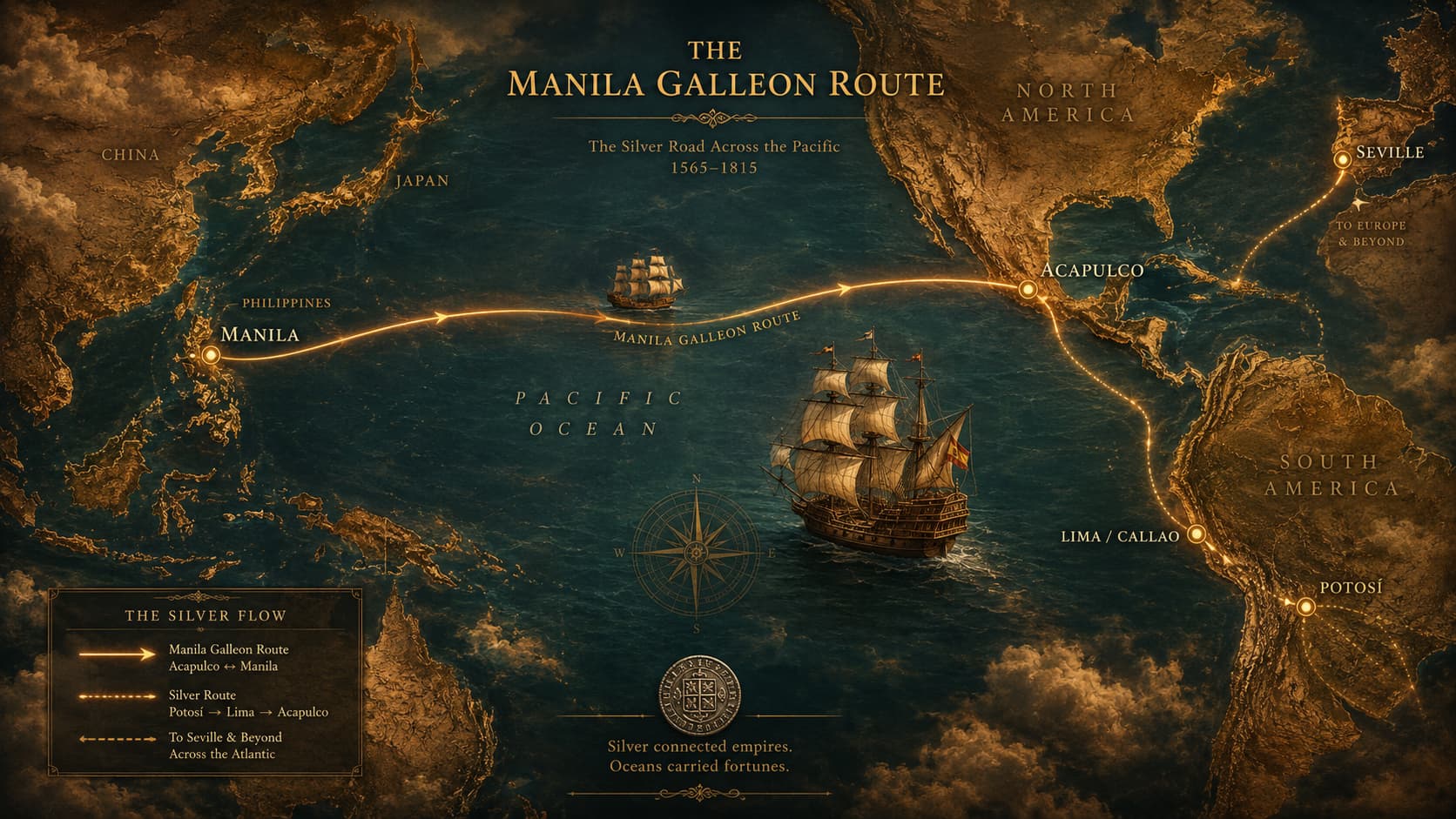
Americas → Europe → Asia
The famous Manila Galleons connected the Spanish Americas with Asian trade networks across the Pacific Ocean.
For the first time:
- goods
- metals
- spices
- silk
- porcelain
- ideas
- technologies
circulated continuously between continents on a global scale.
In many ways, this was the beginning of the interconnected commercial world we still live in today.
How Much Wealth Left the Americas?
The exact modern value of the gold and silver extracted from the Americas is impossible to calculate precisely.
Historians estimate that during the colonial period, Spain transported tens of thousands of tons of silver and large quantities of gold across the Atlantic.
If converted into modern economic influence rather than simple metal prices, the value becomes almost unimaginable.
Because the true impact was not only the metal itself.
It was what the metal financed:
- global shipping systems
- financial institutions
- trade empires
- industrial growth
- military expansion
- international banking
- early stock markets
Part of the infrastructure of the modern global economy was indirectly financed by wealth extracted from the Americas.
Including wealth originating in the Andes.
And What Remained Here?
This is where the story becomes more complex.
If the Americas produced such extraordinary wealth, why did so much inequality remain afterward?
Why did industrial power concentrate elsewhere?
Why did many colonial economies remain dependent on extraction?
The answers are deeply connected to how colonial systems functioned.
Much of the wealth:
- left the continent
- financed external empires
- strengthened foreign financial centers
- accelerated industrialization abroad
while many indigenous populations experienced displacement, exploitation, violence, disease, and cultural destruction.
The consequences of those systems are still visible today across Latin America.
Today, Ecuador’s landscapes and cultures still carry deep layers of natural, historical, and human memory.
From Silver Mines to Modern Resources
Centuries later, the questions remain surprisingly familiar.
In the colonial era, the world wanted:
- gold
- silver
- spices
- sugar
Today the world seeks:
- oil
- lithium
- rare earth minerals
- biodiversity
- strategic ecosystems
- data
- freshwater
The central question remains the same:
Who benefits most from natural wealth?
And how can countries rich in resources also build long-term prosperity for their own people?
A Global Story That Began in the Andes
The story of American gold and silver is not only about conquest or treasure.
It is also the story of how the modern world became connected.
The mountains of the Americas helped finance empires, reshape commerce, accelerate global trade, and transform the world economy forever.
From the Andes to Amsterdam, from Spanish fleets to Chinese markets, the flow of silver linked continents into a new global system.
And in many ways, part of the modern world was built with metal extracted from the mountains of the Americas.
Ecuador • History • Andes • Cultural Exploration
Explore the Landscapes That Helped Shape Global History
From ancient Andean civilizations and colonial trade routes to volcanoes, indigenous cultures, and remote mountain communities, Ecuador offers one of the most fascinating intersections of nature, history, and human civilization in South America.
Explore Private Ecuador JourneysNature, history, wildlife, and meaningful travel experiences across Ecuador & the Galápagos.
