

Barefoot Journal · Ecuador History · Andes Mystery
Atahualpa's Lost Resting Place?
The Malqui-Machay Mystery in Cotopaxi
Some places in Ecuador are beautiful.
Others are beautiful, and unfinished.
High in Cotopaxi's western Andes, beyond the famous turquoise crater of Quilotoa and the mountain roads around Sigchos, there is a story that still feels unresolved.
It is the story of Atahualpa, the last sovereign Inca ruler. The story of Rumiñahui, resistance, and the fall of an empire. And the story of Malqui-Machay, an archaeological site that some researchers have connected to one of the greatest unanswered questions in Andean history.
Could Atahualpa's final resting place be hidden somewhere in this region of Ecuador?
The answer is not confirmed.
And that is exactly what makes the story so powerful.
The Landscape Behind the Mystery
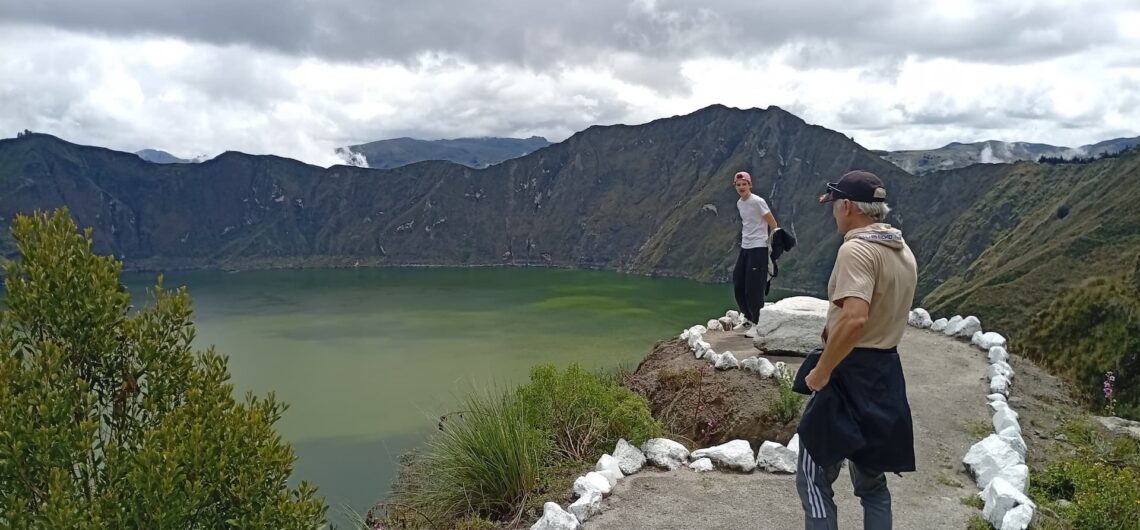
Most travelers know Quilotoa for its volcanic beauty. The crater lake is one of Ecuador’s most dramatic landscapes: a high-altitude caldera filled with mineral-colored water, surrounded by wind, páramo, trails, and small Andean communities.
But Quilotoa is not an isolated destination.
It belongs to a wider cultural and geographic corridor that includes Sigchos, Isinliví, Chugchilán, Zumbahua, and the western slopes of Cotopaxi. This is a landscape of ancient routes, deep ravines, cloud forest transitions, traditional villages, and hidden paths.
For many visitors, it is a trekking region.
For those who look deeper, it is also a historical landscape.
A place where geography, memory, and mystery overlap.
Atahualpa and the Question That Never Fully Disappeared
In 1532, Atahualpa was captured by the Spanish in Cajamarca. His execution marked one of the most dramatic turning points in the history of the Andes.
But after his death, one question remained open:
What happened to his body?
In the Andean world, the body of a ruler was not simply a physical remain. It could carry political, spiritual, and symbolic power. The memory of a leader could continue to shape identity, loyalty, and resistance long after death.
This is why the mystery of Atahualpa’s final destination still matters.
It is not only a question of archaeology.
It is a question of memory.
Malqui-Machay: A Site Hidden in the Sigchos Region
The name Malqui-Machay is often translated in relation to the idea of a sacred body, a cave, or a place connected with ancestral presence. The site is located in the broader Sigchos–Chugchilán area of Cotopaxi, a region that still feels remote, dramatic, and naturally protected.
Ecuadorian historian Tamara Estupiñán developed one of the most important modern hypotheses linking Malqui-Machay with the final fate of Atahualpa. Her work brought renewed attention to this area and suggested that the western Andean slopes of Cotopaxi may have played a much more important role in late Inca history than many travelers realize.
Local heritage descriptions identify Malqui-Machay as a late-Inca archaeological complex, with a formal entrance passage, rectangular rooms, a trapezoidal plaza, cut stone, water channels, and a possible Inca bath.
That does not prove that Atahualpa is buried there.
But it does prove something important:
this region deserves to be read with more depth.
Rumiñahui and the Geography of Resistance
Any serious story about Atahualpa’s final fate must also speak of Rumiñahui.
After the Spanish conquest began to unfold, Rumiñahui became one of the great symbols of indigenous resistance in the northern Andes. His name is tied to the defense of Quito, the protection of Inca power, and the effort to preserve what remained after the fall of Atahualpa.
The Sigchos region makes sense within this story.
It is not an easy landscape.
It is rugged, layered, and naturally defensive.
It has ravines, ridges, forested slopes, narrow routes, and hidden valleys.
This is not only beautiful terrain.
It is strategic terrain.
A place where people could disappear.
A place where memory could survive.
A place where a story could be protected for centuries.
Quilotoa Beyond the Postcard
Quilotoa is often photographed as a perfect crater lake. And it is.
But the deeper power of the region is not only in the view. It is in what surrounds it.
The trails from Sigchos to Isinliví, from Isinliví to Chugchilán, and from Chugchilán toward Quilotoa cross one of Ecuador’s most evocative Andean landscapes. These paths move through farmland, canyons, indigenous communities, páramo, and volcanic terrain.
With the right context, a trek here becomes more than a hike.
It becomes a journey through layers:
volcanoes, empire, conquest, resistance, local memory, and living Andean culture.
This is where the Barefoot approach begins.
Not just to show the landscape.
But to help travelers understand what they are looking at.
Related Private Journey
Explore the Quilotoa Loop with Barefoot Expeditions
Walk through one of Ecuador’s most dramatic Andean landscapes — from rural highland villages and deep canyons to the volcanic crater of Quilotoa. Our private Quilotoa Loop journeys can be adapted with cultural context, flexible pacing, and local insight.
View the Quilotoa Loop JourneyWhy This Story Matters Today
The mystery of Malqui-Machay is not valuable because it gives us an easy answer.
It is valuable because it invites better questions.
What parts of Ecuador’s history remain under-told?
What landscapes have been reduced to scenery, when they are also archives of memory?
What would happen if travelers moved through the Andes with more curiosity, more respect, and more historical awareness?
In a country as layered as Ecuador, travel should not only be about reaching famous places.
It should also be about learning how to read them.
A Responsible Way to Experience the Region
At Barefoot Expeditions, we do not present Malqui-Machay as a confirmed tomb. We approach it as a serious historical hypothesis, part of a much larger story about Atahualpa, Rumiñahui, Cotopaxi, Sigchos, and the living Andes.
You do not need to visit Malqui-Machay directly to begin engaging with this history.
A journey through Quilotoa, Chugchilán, Isinliví, Sigchos, and Cotopaxi already opens the door to this deeper landscape.
This is the kind of travel we believe in:
private, thoughtful, locally grounded, and designed for travelers who want more than a standard route.
Final Reflection
Some places ask to be photographed.
Others ask to be decoded.
Quilotoa does both.
Its crater is one of Ecuador’s great natural wonders. But around it lies something even deeper: a landscape of memory, resistance, and unanswered history.
Somewhere between the mountains of Cotopaxi, the valleys of Sigchos, and the old paths of the Andes, the story of Atahualpa still lingers.
Not as a certainty.
As an invitation.
To walk slower.
To look deeper.
And to understand Ecuador beyond the obvious.
Private Andes Journeys
Walk Through One of Ecuador’s Most Powerful Historical Landscapes
Explore Quilotoa, Chugchilán, Sigchos, and the Ecuadorian Andes with a deeper sense of place. Barefoot Expeditions designs private journeys that combine dramatic landscapes, local insight, flexible pacing, and meaningful cultural context.
Plan Your Private Quilotoa JourneyPrivate, custom-designed journeys through Quilotoa, Cotopaxi, and the Ecuadorian Andes.
