

La Cueva de los Tayos: The Legendary Amazon Expedition That Drew Neil Armstrong Underground
After walking on the Moon, Neil Armstrong joined an expedition that went in the opposite direction—deep into the Earth.
In 1976, he traveled to southeastern Ecuador to enter one of South America’s most iconic and debated cave systems: La Cueva de los Tayos.
But the real story of Tayos is not just “Armstrong + mystery.”
It is the rare convergence of geology, archaeology, biodiversity, Indigenous guardianship, and decades of myth tested against evidence.
This page exists to answer clearly what so many people search for:
What is La Cueva de los Tayos really about—and can it be visited responsibly today?
A Cave Shaped by Deep Time
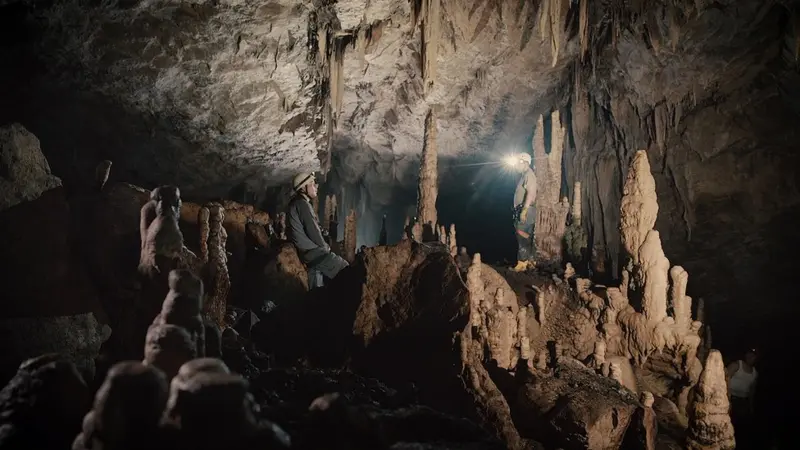
La Cueva de los Tayos is a vast limestone cave system formed over millions of years through water erosion and tectonic processes. Access begins with a dramatic vertical descent of roughly 70 meters, opening into a complex network of chambers, galleries, underground rivers, waterfalls, and massive speleothems.
Inside, natural light disappears completely.
Life adapted—or vanished.
One of the cave’s most emblematic inhabitants is the oilbird (Steatornis caripensis), a nocturnal species uniquely adapted to navigate in total darkness using echolocation. Their calls echo through the chambers, a constant reminder that this is a living ecosystem, not an empty void.
Shuar Territory and Living Guardianship
Long before international expeditions, La Cueva de los Tayos was known and protected by the Shuar people, particularly the Kuankus community. For them, the cave is not a mystery or a myth—it is part of a living ancestral territory tied to history, identity, and survival.
Access to the cave today is inseparable from Indigenous consent, cultural respect, and local coordination. Any meaningful exploration must begin with this understanding.
Why the World Took Notice
Global fascination intensified in the 1960s and 1970s after claims suggested the presence of metal plates or artificial structures deep inside the cave. These ideas—popularized by explorers such as Juan Moricz—sparked decades of debate and sensational theories.
Rather than allowing speculation to dominate, Ecuador and the international scientific community responded with something far more valuable: rigorous exploration.
The 1976 Expedition: Evidence Over Speculation
In 1976, a major Ecuadorian–British expedition entered La Cueva de los Tayos. Led by British explorer Stanley Hall, the team included geologists, archaeologists, engineers, military specialists, and scientists.
Among them was Neil Armstrong.
His presence did not validate extraordinary claims.
It validated the seriousness and credibility of the expedition.
Over several weeks, the team:
-
mapped extensive cave passages,
-
conducted geological and biological sampling,
-
documented archaeological evidence of human presence.
What they did not find were artificial “libraries,” non-human artifacts, or proof of advanced lost civilizations.
What they confirmed was far more important:
La Cueva de los Tayos is extraordinary because it is natural—and because humans have interacted with this environment for thousands of years.
The Portal Moricz: When Geology Looks Artificial
One of the most discussed features inside the cave is the Portal Moricz—a striking formation with smooth, flat surfaces that appear almost architectural.
This visual impact has fueled speculation for decades. However, geologist Theofilos Toulkeridis explains that the cave is karstic, with unique sandstone influences that can produce flat, planar walls through entirely natural geological processes.
In short:
the cave looks artificial in places—
but science can explain why.
Archaeology, Ecology, and Reality
Research and documentation in and around La Cueva de los Tayos point to:
-
evidence of ancient human presence in the region (often cited as over 10,000 years in Amazonian archaeology),
-
archaeological materials such as tools and pottery fragments,
-
a fragile cave ecosystem with specialized fauna,
-
geological formations shaped by long-term hydrological activity.
The conclusion is clear:
the truth is more impressive than the myth.
A Modern Perspective: Exploration Without Illusion
Filmmaker Miguel Garzón entered the cave to document what it actually feels like to be there—where the debate between mysticism and science exists not in theory, but in darkness, rock, and physical effort.
One fact remains unchanged:
no one has fully explored every branch of La Cueva de los Tayos.
Some sections remain extremely technical, involving submerged passages and advanced skills beyond standard expeditions.
This is not tourism.
It is frontier exploration.
Can You Visit La Cueva de los Tayos Today?
Yes—but only through professionally organized, legal, and safety-first expeditions.
Responsible access requires:
-
certified guides trained in speleology and canyoning,
-
technical safety equipment and protocols,
-
official permissions and community coordination,
-
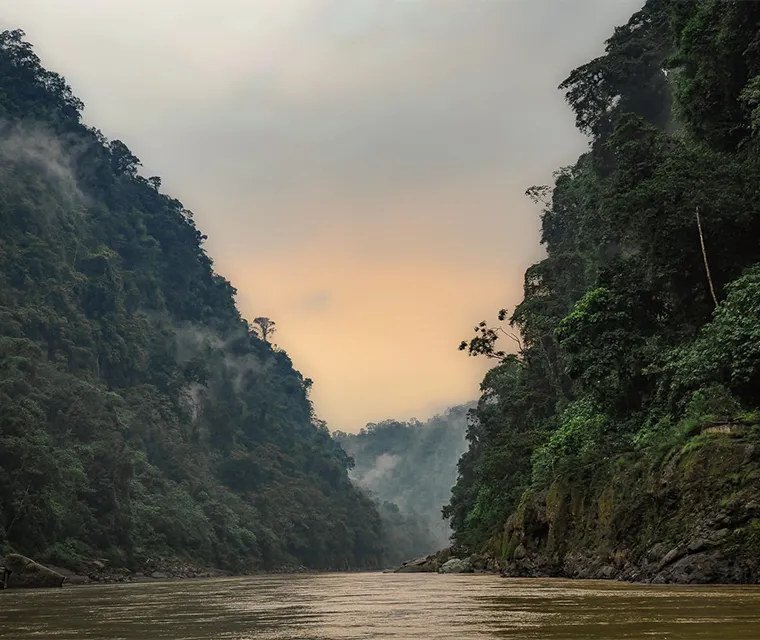
multi-day logistics including river transport, jungle access, and camping.
This is not a casual adventure.
And it should never be approached as one.
Barefoot Expeditions and La Cueva de los Tayos
At Barefoot Expeditions, we curate journeys that balance legend-level curiosity with evidence-based context and real responsibility.
We offer La Cueva de los Tayos as a Signature Expedition because it demands:
-
preparation over improvisation,
-
understanding over spectacle,
-
respect over extraction.
This is expedition travel done properly.
Example Expedition Structure (Reference Only)
The outline below is provided to illustrate how responsible access is typically organized. Details may vary depending on conditions, permits, group profile, and community coordination.
3 Days / 2 Nights
Day 1 – Arrival & cultural orientation
Meet in Santiago de Méndez → river navigation → waterfalls and swimming time → jungle lunch → transfer toward the Shuar Kuankus area → hike to Don Bosco Refuge → camp setup → community welcome → dinner and campfire.
Day 2 – Technical descent & cave exploration
Breakfast → safety briefing and gear check → assisted descent (~70–74 m) → exploration of chambers, galleries, underground rivers, and cascades → lunch inside the cave → rest at internal waterfalls → community-led evening activities.
Day 3 – Ascent & return
Light breakfast → assisted ascent → lunch at the refuge → return to Macas → farewell.
Why La Cueva de los Tayos Still Captivates
People are drawn to La Cueva de los Tayos because it represents something rare:
-
real exploration in an over-exposed world,
-
a place where myth was tested by evidence,
-
a landscape still governed by nature and community.
It is not mystery for sale.
It is understanding earned through effort.
